📋 Course Outline
- Diphyllobothriasis epidemiology, morphology, and life cycle
- Clinical manifestations and diagnosis of diphyllobothriasis
- Taenia solium and T. saginata life cycle and human infection
- Pathology, clinical features, and complications of taeniasis and cysticercosis
- Hymenolepis nana infection, life cycle, clinical symptoms, diagnosis, and treatment
- Echinococcus granulosus life cycle and epidemiology of cystic echinococcosis
- Hydatid cyst development, pathology, and host interactions
- Differences in life cycles and hosts of Echinococcus multilocularis, E. vogeli, and E. oligarthrus
- Clinical manifestations and organ involvement in cystic and alveolar echinococcosis
- Diagnosis and clinical signs of cystic echinococcosis including secondary infection
- Treatment options for hydatid cysts including surgery, chemotherapy, and PAIR technique
- Prevention and control measures for cestode infections
📖 1. Diphyllobothriasis epidemiology, morphology, and life cycle
🔑 Key Concepts & Definitions
- Epidemiology : Sparganosis is rare but reported in endemic areas, particularly in parts of Asia, such as China, Japan, and Korea, as well as some regions in Africa and South America.
- Diphyllobothrium latum : A species of tapeworm that is the longest found in humans, measuring between 3 and 10 meters and consisting of more than 3000 proglottids.
- Plerocercoid larvae : Man and other animals are infected by eating uncooked fish that contains plerocercoid larvae (15 x 2 mm) which attach to the small intestinal wall and mature into adult worms in 3 to 5 weeks.
📝 Essential Points
- Diphyllobothriasis is distributed worldwide, mainly in subarctic and temperate regions, associated with eating raw or undercooked freshwater fish.
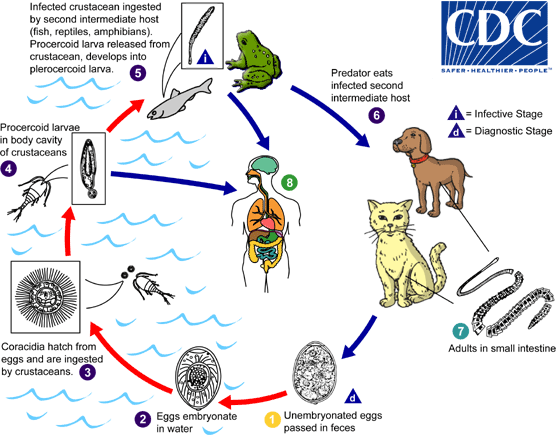
- The life cycle involves eggs hatching in freshwater, developing into coracidium, ingested by Cyclops to form procercoid, then infecting fish as plerocercoid larvae, and infecting humans via raw fish.
- Humans and animals become infected by eating uncooked fish with plerocercoid larvae, which mature into adult worms in 3 to 5 weeks.
- When infected Cyclops are ingested by the freshwater fish, the procercoid larva penetrates the intestinal wall and develops into a plerocercoid larva, infectious to man.
- This is the longest tapeworm found in man, ranging from 3-10 meters with more than 3000 proglottids.
💡 Key Takeaway
Diphyllobothriasis is distributed worldwide, mainly in subarctic and temperate regions, associated with eating raw or undercooked freshwater fish.
📖 2. Clinical manifestations and diagnosis of diphyllobothriasis
🔑 Key Concepts & Definitions
- Diet : The pattern of food consumption, which influences the risk of diphyllobothriasis, with less than 2% of patients developing anemia despite decreased vitamin B12 levels.
- Outcomes : The clinical consequences of diphyllobothriasis vary, with mild infections causing abdominal discomfort and heavy infections potentially leading to vitamin B12 deficiency, anemia, and neurological complications.
- Subacute combined degeneration of the spinal cord : A neurological condition that can develop as a complication of severe vitamin B12 deficiency caused by heavy diphyllobothriasis infection.
- Clinical Infectious Diseases : A medical journal cited as a source discussing the clinical spectrum and diagnostic methods of diphyllobothriasis.
📝 Essential Points
- Clinical manifestations depend on worm burden; mild infections cause abdominal discomfort, loss of appetite, weight loss, and malnutrition.
- Diagnosis is by microscopic stool examination for ova and parasites and complete blood count showing possible low hemoglobin and hematocrit levels.
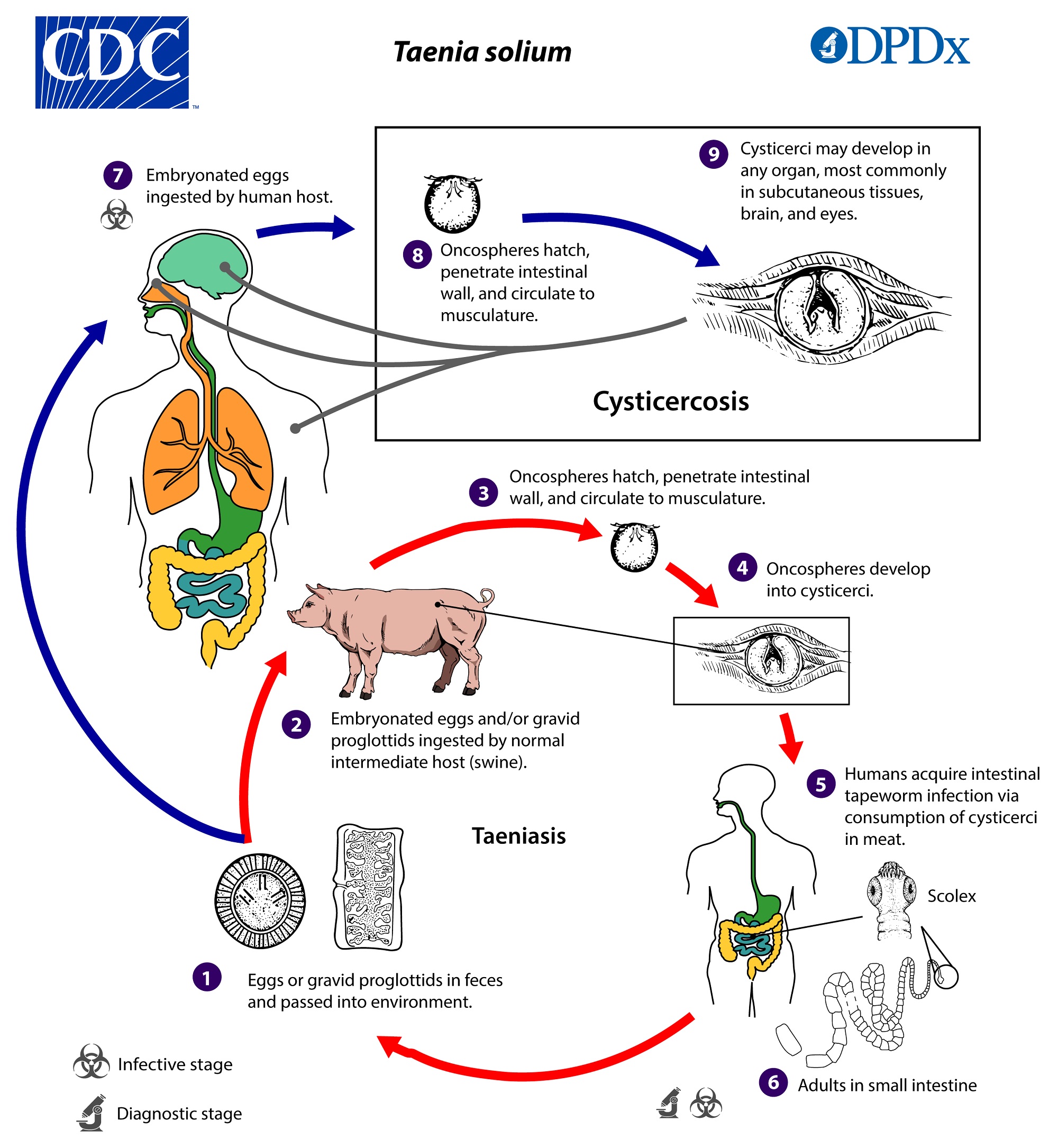
- B-12 levels. Vitamin supplementation may be required in severe cases. Prevention. Freeze fish for 24 hours. Thoroughly cook fish. Pickling fish. Preventing sewage contamination of fish reservoirs. 2. Teniasis (T. solium & T. saginata) Cestodiasis is the term for being infected with a cestode. Adult cestodiasis occurs when a human is infected with an adult tapeworm. Epidemiology. Teniasis is caused by Tenia solium or T. saginata. These cestodes have a worldwide distribution but incidence is higher in developing countries. Infection rate is as low as 1 per 1000 in most of North America and as high as 10% in the third world. Pork tapeworm shows a higher incidence but this is dependent on dietary habits. T. saginata worms can be found worldwide in countries where cattle are raised for human consumption. The frequency of beef tapeworm has decreased in developed countries owing to stricter meat inspection practices, better hygiene, and significantly better sanitary facilities. In developing countries, particularly in pastoral societies and rural areas, where sanitary installations are not an element of the culture and where human excrement is disposed of on open ground, used to fertilize, or even used for medicinal purposes (12), both T. saginata and T. solium continue to flourish. Morphology. . saginata can be up to 4 to 6 meters long and 12 mm broad; it has a pear-shaped head (scolex) with four suckers but no hooks or neck. It has a long flat body with several hundred segments (proglottids). Each segment is about 18 x 6 mm with a branched uterus (15-30 branches). The egg is 35 x 45 micrometers, roundish and yellow-brown. It has peripheral radial striations and contains an embryo with 3 hooklets. T. solium is slightly smaller than T. saginata. It has a globular scolex with four suckers and a circular row of hooks (rostellum) that gives it a solar appearance. There is a neck and it has a long flat body (0.1 meter in length). The proglottids are 5 x 10 mm with a 7-12 branch uterus. The eggs of T. solium and T. saginata are indistinguishable. Life cycle (fig 27). A tapeworm larval cyst (cysticercus) is ingested with poorly cooked infected meat; the larva escapes the cyst and passes to the small intestine where it attaches to the mucosa by the scolex suckers. The proglottids develop as the worm matures in 3 to 4 months. The adult may live in the small intestine as long as 25 years and pass gravid proglottids with the feces. Eggs extruded from the proglottid contaminate and persist on vegetation for several days and are consumed by cattle or pigs in which they hatch and form cysticerci. https://www.cdc.gov/dpdx/taeniasis/modules/Taenia_LifeCycle.gif?_=96656 Fig. 27 – Life cycle Tenia solium and T. saginata Pathology and pathogenesis. Clinical features. Light infections remain asymptomatic, but heavier infections may produce abdominal discomfort, epigastric pain, vomiting and diarrhea. Complications. Acute surgical abdomen, appendicitis, or obstructed bile or pancreatic ducts. Human cysticercosis. Human cysticercosis is caused by the development of T. solium oncospheres to the larval stage, or cysticercus, in the interstitial tissues of humans. Because the oncospheres are transported passively from the intestinal wall through the circulation, they can lodge in almost any tissue, but cysticerci are most frequently found in brain, skeletal muscle, and subcutaneous tissues. By far the most important clinicopathologic picture is the one these parasites produce in the CNS. Cysticercosis is the most common parasitosis affecting the CNS and a major cause of neurological disease. It is considered an emerging public health problem and been reported to be increasing in countries that receive immigrants from countries where the tapeworm is endemic. The incidence of cerebral cysticercosis can be as high 1 per 1000 population and may account for up to 20% of neurological case in some countries (e.g., Mexico); cysticercosis ocular involvement occurs in about 2,5% of patients and muscular involvement is as high as 10% (India).
- Complete blood cell count: hemoglobin and hematocrit levels may be below or at the lower end of the reference range.
💡 Key Takeaway
Recognizing the clinical spectrum and diagnostic methods of diphyllobothriasis is critical for timely identification and management.
📖 3. Taenia solium and T. saginata life cycle and human infection
🔑 Key Concepts & Definitions
- Infected with : The state of harboring a cestode parasite, such as an adult tapeworm or its larval forms.
- Gravid proglottids : Gravid proglottids release eggs (
- Life cycle : The same life cycle occurs with E.
📝 Essential Points
- Adult tapeworms mature in 3 to 4 months and may live up to 25 years, releasing gravid proglottids with eggs in feces.
- Eggs contaminate vegetation and are ingested by cattle or pigs, where they hatch and form cysticerci, completing the life cycle.
- The adult may live in the small intestine as long as 25 years and pass gravid proglottids with the feces.
- Eggs extruded from the proglottid contaminate and persist on vegetation for several days and are consumed by cattle or pigs in which they hatch and form cysticerci.
💡 Key Takeaway
The life cycle of Taenia species highlights the importance of meat hygiene and understanding larval development for infection control.
📖 4. Pathology, clinical features, and complications of taeniasis and cysticercosis
🔑 Key Concepts & Definitions
- Sparganosis : A parasitic infection caused by larvae of Spirometra tapeworms, particularly Spirometra mansoni, commonly found in tissues of amphibians, reptiles, and fish.
- Worldwide Distribution : Taeniasis and cysticercosis have a worldwide distribution, with higher incidence in developing countries where sanitation and hygiene are inadequate.
- Human cysticercosis : An infection caused by the development of Taenia solium oncospheres into cysticerci in tissues, most frequently in brain, skeletal muscle, and subcutaneous tissues.
📝 Essential Points
- Light taeniasis infections are often asymptomatic; heavier infections cause abdominal discomfort, epigastric pain, vomiting, and diarrhea.
- Human cysticercosis results from T. solium oncospheres developing into cysticerci in tissues, especially brain, muscle, and subcutaneous tissue.
- Neurocysticercosis is the most common parasitic CNS infection causing significant morbidity.
- Because the oncospheres are transported passively from the intestinal wall through the circulation, they can lodge in almost any tissue, but cysticerci are most frequently found in brain, skeletal muscle, and subcutaneous tissues.
- Light infections remain asymptomatic, but heavier infections may produce abdominal discomfort, epigastric pain, vomiting and diarrhea.
💡 Key Takeaway
Understanding the dual pathology of taeniasis and cysticercosis is vital due to their distinct clinical presentations and serious complications.
📖 5. Hymenolepis nana infection, life cycle, clinical symptoms, diagnosis, and treatment
🔑 Key Concepts & Definitions
- Niclosamide : Adults, 2 gm in a single dose for 7 days;
- Hymenolepis nana : A small cestode parasite that most commonly infects humans, especially children, often causing asymptomatic infections but capable of producing symptoms related to worm burden.
- Clinical Presentation : The disease often progresses slowly with many infections being asymptomatic; when symptoms occur, they include gastrointestinal and pruritic manifestations.
📝 Essential Points
- Humans acquire Hymenolepis nana infection mainly through ingestion of infective eggs via fecal-oral exposure.
- Eggs hatch in the ileum, larvae penetrate villi, mature into cysticercoid larvae, and adults attach to villus mucosa.
- Most infections are asymptomatic; symptoms, when present, include restlessness, irritability, diarrhea, abdominal pain, and pruritus, with symptoms increasing with worm burden.
- Diagnosis is made by detecting eggs in stool; eosinophilia occurs in about one-third of infected children.
💡 Key Takeaway
Comprehensive understanding of Hymenolepis nana’s life cycle and clinical management is essential for controlling this common fecal-oral cestode infection.
📖 6. Echinococcus granulosus life cycle and epidemiology of cystic echinococcosis
🔑 Key Concepts & Definitions
- Echinococcus granulosus : Echinococcosis Echinococcus granulosus and E.
- Intermediate host : Small rodents;
📝 Essential Points
- Echinococcus granulosus lives in the small bowel of definitive hosts, mainly dogs and canids.
- Eggs released by gravid proglottids are passed in feces and ingested by intermediate hosts such as sheep, goats, swine, cattle, horses, and camels.
- Eggs hatch in the small bowel of intermediate hosts, releasing oncospheres that penetrate the intestinal wall and migrate to organs, especially the liver and lungs.
- Oncospheres develop into hydatid cysts that enlarge gradually, producing protoscolices and daughter cysts.
- Definitive hosts become infected by ingesting cyst-containing organs of intermediate hosts, completing the cycle.
- The definitive host becomes infected by ingesting the cyst-containing organs of the infected intermediate host.
💡 Key Takeaway
The complex life cycle and epidemiology of Echinococcus granulosus underpin the global burden of cystic echinococcosis and its zoonotic transmission.
📖 7. Hydatid cyst development, pathology, and host interactions
🔑 Key Concepts & Definitions
- Site : Гродненский государственный медицинский университет Course: ETC Tropic and parasite diseases saginata Pathology and pathogenesis.
- Etiotropic : A treatment approach aimed directly at eliminating the causative parasite, such as surgical removal of cysts or administration of antiparasitic drugs.
- Visceral Sparganosis : Involves internal organs such as the brain, lungs, or gastrointestinal system, leading to more severe symptoms like abdominal pain, neurological deficits, or respiratory issues.
- Hydatid cyst : multilocularis are causative agents of hydatid cysts.
📝 Essential Points
- Hydatid cysts develop slowly in intermediate hosts' organs, mainly liver and lungs, producing protoscolices and daughter cysts filling the cyst interior.
- Cyst contents may trigger anaphylactic reactions if ruptured.
- Loss of appetite, weight loss, and weakness are common systemic symptoms.
- Brain cysts produce intracranial pressure and Jacksonian epilepsy.
💡 Key Takeaway
Understanding hydatid cyst growth and host pathology is crucial for anticipating clinical complications and managing echinococcosis.
📖 8. Differences in life cycles and hosts of Echinococcus multilocularis, E. vogeli, and E. oligarthrus
🔑 Key Concepts & Definitions
- Echinococcus multilocularis : Alveococcosis: A review of clinical features, diagnosis, and treatment.
- Definitive hosts : Hosts in which the adult tapeworm resides, mainly foxes, with secondary hosts including dogs, cats, coyotes, and wolves.
📝 Essential Points
- E. multilocularis's definitive hosts are mainly foxes, with secondary hosts like dogs, cats, coyotes, and wolves.
- E. vogeli's definitive hosts are bush dogs and dogs; its intermediate hosts are rodents, with larval development forming multiple vesicles.
- E. oligarthrus's definitive hosts are wild felids; intermediate hosts are rodents.
- Humans become infected by ingesting eggs, leading to oncosphere development in various organs.
💡 Key Takeaway
Recognizing species-specific life cycle and host differences among Echinococcus spp. informs diagnosis and epidemiological control strategies.
📖 9. Clinical manifestations and organ involvement in cystic and alveolar echinococcosis
🔑 Key Concepts & Definitions
- Alveolar echinococcosis : Clinical presentation, diagnosis, and treatment.
- Cystic echinococcosis : Be differentiated from benign cysts, cavitary tuberculosis, mycoses, abscesses, and benign or malignant neoplasms.
- Other organs : Organs less commonly affected by hydatid cysts include the spleen, kidneys, heart, bone, and central nervous system.
- Patients with : patients with cysts difficult to access;
📝 Essential Points
- Cystic echinococcosis incubation is prolonged; most cases remain asymptomatic until cysts enlarge causing organ dysfunction.
- Liver is the most common site (98%) for hydatid cysts, followed by lungs; other sites include spleen, kidneys, heart, bone, CNS.
- Large cysts cause discomfort, obstructive jaundice, pulmonary abscesses, intracranial pressure, renal dysfunction, and anaphylaxis.
- Alveolar echinococcosis primarily infects the liver, often the right lobe, with direct extension and hematogenous spread to other organs.
- The incubation period of cystic echinococcosis is often prolonged for several years and most cases of cystic echinococcosis remain asymptomatic until the cysts reach a large enough size to cause dysfunction.
- The primary infection of alveolar echinococcosis is in the liver (60%), usually the right lobe, but direct extension to contiguous organs, as well as hematogenous metastases to the lungs (20%) and brain (<2%) is not uncommon.
💡 Key Takeaway
Differentiating clinical presentations and organ involvement in cystic versus alveolar echinococcosis is key for accurate diagnosis and management.
📖 10. Diagnosis and clinical signs of cystic echinococcosis including secondary infection
🔑 Key Concepts & Definitions
- Diagnostics : A process based on clinical suspicion, imaging techniques such as ultrasound, CT, or MRI, and serological tests detecting Echinococcus antibodies to identify cysts and complications.
- Secondary echinococcosis : A condition where larval tissue spreads from the primary site and new cysts develop after spontaneous or trauma-induced cyst rupture or release of viable parasite material during invasive treatment procedures.
- Signs and symptoms : Clinical manifestations including hepatic enlargement with or without a palpable mass in the right upper quadrant, right epigastric pain, nausea, vomiting, and acute or intermittent allergic reactions resulting from rupture or leakage of hydatid cysts.
📝 Essential Points
- Rupture or leakage of hydatid cysts causes allergic manifestations including anaphylaxis.
- Secondary echinococcosis arises from cyst rupture or invasive treatment releasing viable parasite material.
- Diagnosis relies on clinical signs, imaging, and serology to detect cysts and complications.
- Signs and symptoms may include hepatic enlargement with or without a palpable mass in the right upper quadrant, right epigastric pain, nausea, and vomiting.
- Rupture or leakage usually results in acute or intermittent allergic manifestations.
💡 Key Takeaway
Rupture or leakage of hydatid cysts causes allergic manifestations including anaphylaxis.
📖 11. Treatment options for hydatid cysts including surgery, chemotherapy, and PAIR technique
🔑 Key Concepts & Definitions
- Radical surgery : A surgical approach involving pericystectomy or hepatic resection that is feasible in 50-85% of hepatic hydatid cyst cases, associated with low mortality and acceptable morbidity.
- Treatment involves : Primarily surgical removal of hydatid cysts through cystectomy or pericystectomy, with alternatives including chemotherapy and PAIR when surgery is contraindicated.
📝 Essential Points
- Surgery is the primary treatment for hepatic hydatid cysts, with cystectomy and pericystectomy offering good cure rates.
- Radical surgery including hepatic resection is feasible in 50-85% of cases with acceptable morbidity and low mortality.
- Laparoscopic pericystectomy is as safe and effective as open surgery in selected hepatic and splenic cases.
- In cases of inoperable hydatid cysts, or when the general condition of the patient precludes surgery, albendazole, 10 to 15 mg/kg per day for 1 month, or mebendazole, 50 to 150 mg/kg per day for 3 months, may be administered, although the results are unpredictable.
- Recently, laparoscopic peri-cystectomy has been demonstrated to be as safe and effective as open laparotomy in selected cases with hepatic and/or splenic involvement.
💡 Key Takeaway
Surgery is the primary treatment for hepatic hydatid cysts, with cystectomy and pericystectomy offering good cure rates.
📖 12. Prevention and control measures for cestode infections
🔑 Key Concepts & Definitions
- Non-specific : Symptoms that are not unique to a particular disease, such as painful nodules, inflammation, or organ-specific signs that vary depending on the site of infection.
- Personal hygiene : Proper disposal of sewage.
📝 Essential Points
- Preventing cestode infections requires good personal hygiene and proper disposal of sewage to interrupt transmission.
- Proper cooking or freezing of fish and meat kills infective larvae and prevents human infection.
- Handwashing after handling pets reduces risk of Hymenolepis nana infection due to fecal-oral transmission.
- Contact precautions are necessary as H. nana eggs in stool are infectious.
- Control of definitive and intermediate hosts reduces environmental contamination and human exposure.
- Good handwashing after handling pets should be reinforced.
💡 Key Takeaway
Effective prevention of cestode infections hinges on hygiene, food safety, and environmental control to break parasite transmission cycles.
🧩 Additional Source Details
- Study this source detail: 14. Cestodoses (diphyllobothriasis, teniarinchosis, teniasis, cysticercosis, hymenolepiasis, echinococcosis, alveococcosis, sparganosis). Site: Гродненский государственный медицинский университет Course: ETC Tropic and p (Source: "14. Cestodoses (diphyllobothriasis, teniarinchosis, teniasis, cysticercosis, hymenolepiasis, echinococcosis, alveococcosis, sparganosis). Site: Гродненский государственный медицинский университет Course: ETC Tropic and parasite diseases FFS 6 course \ ЭУМК Тропические и паразитарные болезни ФИУа 6к Book: Lesson 14. Cestodoses (diphyllobothriasis,")
- Study this source detail: fish, usually from the Northern Hemisphere (Europe, newly independent states of the Former Soviet Union, North America, Asia), but cases have also been reported in Uganda and Chile. Fish infected with Diphyllobothrium la (Source: "fish, usually from the Northern Hemisphere (Europe, newly independent states of the Former Soviet Union, North America, Asia), but cases have also been reported in Uganda and Chile. Fish infected with Diphyllobothrium larvae may be transported to and consumed in any area of the world. Adequately freezing or cooking fish will kill the parasite.")
- Study this source detail: mature into adult worms in 3 to 5 weeks. Eggs discharged from gravid proglottids in the small intestine are passed in the feces. The egg hatches in fresh water to produce a ciliated coracidium which needs to be ingested (Source: "mature into adult worms in 3 to 5 weeks. Eggs discharged from gravid proglottids in the small intestine are passed in the feces. The egg hatches in fresh water to produce a ciliated coracidium which needs to be ingested by a water flea (Cyclops) where it develops into a procercoid larva. When infected Cyclops are ingested by the freshwater fish, the")
- Study this source detail: for ova and parasites. Diagnosis. Complete blood cell count: hemoglobin and hematocrit levels may be below or at the lower end of the reference range. he mean cell volume may be above or at the higher end of the referenc (Source: "for ova and parasites. Diagnosis. Complete blood cell count: hemoglobin and hematocrit levels may be below or at the lower end of the reference range. he mean cell volume may be above or at the higher end of the reference range. Eosinophilia may be present. Vitamin B-12 level and Folate level deficit Treatment. Praziquantel, adults, 5-10 mg/kg")
- Study this source detail: approximately 40%; ventricular system, approximately 10%; mixed areas, more than 50%; spine, approximately 1%. Parenchymal cysts can be single or multiple. The majority of these larvae, when viable, are 1 or 2 cm in diam (Source: "approximately 40%; ventricular system, approximately 10%; mixed areas, more than 50%; spine, approximately 1%. Parenchymal cysts can be single or multiple. The majority of these larvae, when viable, are 1 or 2 cm in diameter, are filled with fluid, and have an invaginated scolex. They are observed in children and young adults and frequently cause no")
- Study this source detail: of late-onset epilepsy in several endemic countries. When parasites lodge in the ventricular cavities, they may become trapped in lateral ventricles, the fourth ventricle (by far the most frequent ventricular location), (Source: "of late-onset epilepsy in several endemic countries. When parasites lodge in the ventricular cavities, they may become trapped in lateral ventricles, the fourth ventricle (by far the most frequent ventricular location), or the aqueduct. If the cyst is free, it may cause little inflammatory reaction. The clinical manifestations are the result of")
- Study this source detail: with headache, nausea, vomiting, and papilledema associated with disturbances in the cerebellar functions (dizziness, vertigo, and loss of equilibrium and motor coordination). In other cases, the cyst adheres to the base (Source: "with headache, nausea, vomiting, and papilledema associated with disturbances in the cerebellar functions (dizziness, vertigo, and loss of equilibrium and motor coordination). In other cases, the cyst adheres to the base of the fourth ventricle, inducing an inflammatory response with ependymitis characterized by signs of brain dysfunction. Cysticerci")
- Study this source detail: that are at present not understood, the parasite located in the ventricles frequently becomes of the racemose type. In cases in which the inflammatory process advances or increases, it can induce vasculitis or neuritis w (Source: "that are at present not understood, the parasite located in the ventricles frequently becomes of the racemose type. In cases in which the inflammatory process advances or increases, it can induce vasculitis or neuritis with local or distant ischemic phenomena, all of which are responsible for further brain damage and functional deterioration.")
- Study this source detail: parenchymal cysts. Diagnosis. NCC should be suspected when the patient is known to live or to have lived in an endemic zone or country or has a clinical history of taeniasis or a family member who does; when there is chr (Source: "parenchymal cysts. Diagnosis. NCC should be suspected when the patient is known to live or to have lived in an endemic zone or country or has a clinical history of taeniasis or a family member who does; when there is chronic, persistent, atypical headache that is resistant to ordinary treatment, or seizures in young adults; when there are neurologic")
- Study this source detail: against T. solium in 92% of serum samples and 100% of CSF samples from patients with cysticercosis. An additional enzyme- linked immunoelectrotransfer blot assay based on affinity of purified glycoprotein antigens and le (Source: "against T. solium in 92% of serum samples and 100% of CSF samples from patients with cysticercosis. An additional enzyme- linked immunoelectrotransfer blot assay based on affinity of purified glycoprotein antigens and lentil lectin has reported a 98% sensitivity and 100% specificity in detecting antibodies in serum and CSF from patients with")
- Study this source detail: in stool or from the perianal area. Differential Diagnosis of Taenia solium and Taenia saginata Infestations. Taeniasis can be diagnosed on the basis of the following findings: · A careful clinical history and questionin (Source: "in stool or from the perianal area. Differential Diagnosis of Taenia solium and Taenia saginata Infestations. Taeniasis can be diagnosed on the basis of the following findings: · A careful clinical history and questioning of patients about ingestion of raw beef or pork (particularly sausages). · Discharging of proglottids or worm segments in the stool")
- Study this source detail: should be advised that he or she is a potential risk to other humans, instructed on hygiene measures, and treated as soon as possible. The patient should also be asked to recover the tapeworm (taking all safety precautio (Source: "should be advised that he or she is a potential risk to other humans, instructed on hygiene measures, and treated as soon as possible. The patient should also be asked to recover the tapeworm (taking all safety precautions and using gloves and a disposable or autoclavable container) and bring it into the laboratory for definitive diagnosis. From the")
- Study this source detail: it is virtually impossible to establish a definitive diagnosis. Two promising new techniques for the detection of taeniid antigens in stool specimens have been worked out by several groups: (a) antigen capture and detect (Source: "it is virtually impossible to establish a definitive diagnosis. Two promising new techniques for the detection of taeniid antigens in stool specimens have been worked out by several groups: (a) antigen capture and detection by enzyme- linked immunosorbent assay (ELISA), and the preparation of specific deoxyribonucleic acid (DNA) probes for the")
- Study this source detail: which may lead to seizures or other symptoms. Niclosamide is an alternative, given at 2 g orally once for adults and 50 mg/kg orally once for children. For children weighing between 11 and 34 kg, the recommended dose is (Source: "which may lead to seizures or other symptoms. Niclosamide is an alternative, given at 2 g orally once for adults and 50 mg/kg orally once for children. For children weighing between 11 and 34 kg, the recommended dose is 1 g. Children younger than 2 years of age are given 0,5 g in one dose, the tablets ground to powder and mixed with water. Niclosamide is")
- Study this source detail: effects, which have been observed in experimental animals. The recommended dose for treatment of tapeworms is 6,6 mg/kg (two doses of 200 mg each per day on 3 consecutive days). After treatment, stools should be collecte (Source: "effects, which have been observed in experimental animals. The recommended dose for treatment of tapeworms is 6,6 mg/kg (two doses of 200 mg each per day on 3 consecutive days). After treatment, stools should be collected for 3 days to search for tapeworm proglottids for species identification. Stools should be re-examined for Taenia eggs 1 and 3")
- Study this source detail: 50 mg/kg daily for 15 days. About 2 or 3 days after the treatment is started, a strong inflammatory reaction occurs, with increased protein levels and cells in CSF, headaches, exacerbation of neurologic symptoms, and ede (Source: "50 mg/kg daily for 15 days. About 2 or 3 days after the treatment is started, a strong inflammatory reaction occurs, with increased protein levels and cells in CSF, headaches, exacerbation of neurologic symptoms, and edema around cystic lesions, which can be detected by CT. These reactions can be suppressed with steroids and usually last 2 or 3 days.")
- Study this source detail: or albendazole. These types of NCC require surgery for extirpation of the parasite or insertion of valves to drain CSF and relieve increased intracranial pressure due to hydrocephalus. https://www.cdc.gov/dpdx/cysticerco (Source: "or albendazole. These types of NCC require surgery for extirpation of the parasite or insertion of valves to drain CSF and relieve increased intracranial pressure due to hydrocephalus. https://www.cdc.gov/dpdx/cysticercosis/modules/Cysticercosis_LifeCycle_lg.jpg 4. Hymenolepiasis Hymenolepis nana is the cestode that most commonly infects humans,")
- Study this source detail: and transmission is oro-faecal. Thus cross infection and autoinfection is common in children Life cycle (fig. 29). Humans become infected with H. nana when they ingest infective eggs, most commonly by direct fecal-oral e (Source: "and transmission is oro-faecal. Thus cross infection and autoinfection is common in children Life cycle (fig. 29). Humans become infected with H. nana when they ingest infective eggs, most commonly by direct fecal-oral exposure. The eggs pass into the ileum and hatch into oncospheres (the larval form), which penetrate the lamina propria of the villus.")
- Study this source detail: pdx/hymenolepiasis/modules/H_nana_LifeCycle.gif?=01675 Clinics. The vast majority of infections produce no symptoms. Symptom frequency seems to correlate with increasing worm burden. Among children with clinical infecti (Source: "pdx/hymenolepiasis/modules/H_nana_LifeCycle.gif?=01675 Clinics. The vast majority of infections produce no symptoms. Symptom frequency seems to correlate with increasing worm burden. Among children with clinical infection, symptoms (in order of decreasing frequency) include restlessness, irritability, diarrhea, abdominal pain, restless sleep, anal pruritus,")
- Study this source detail: adults, 2 gm in a single dose for 7 days; children 11-34 kg, 1 gm in a single dose on day 1 then 500 mg per day orally for 6 days; children >34 kg, 1,5 gm in a single dose on day 1 then 1 gm per day orally for 6 days. Ni (Source: "adults, 2 gm in a single dose for 7 days; children 11-34 kg, 1 gm in a single dose on day 1 then 500 mg per day orally for 6 days; children >34 kg, 1,5 gm in a single dose on day 1 then 1 gm per day orally for 6 days. Nitazoxanide: adults, 500 mg orally twice daily for 3 days; children aged 12-47 months, 100 mg orally twice daily for 3 days; children")
- Study this source detail: in rare cases, North America. The incidence of human infection about 1 to 2 per 1000 population and may be higher in rural areas of affected regions. The parasite is transmitted to dogs when they ingest the organs of oth (Source: "in rare cases, North America. The incidence of human infection about 1 to 2 per 1000 population and may be higher in rural areas of affected regions. The parasite is transmitted to dogs when they ingest the organs of other animals that contain hydatid cysts. The disease is most commonly found in people involved in raising sheep, as a result of the")
- Study this source detail: eggs. Life cycle (fig. 30). The adult Echinococcus granulosus (3 to 6 mm long) (1) resides in the small bowel of the definitive hosts, dogs or other canids. Gravid proglottids release eggs (2) that are passed in the fece (Source: "eggs. Life cycle (fig. 30). The adult Echinococcus granulosus (3 to 6 mm long) (1) resides in the small bowel of the definitive hosts, dogs or other canids. Gravid proglottids release eggs (2) that are passed in the feces. After ingestion by a suitable intermediate host (under natural conditions: sheep, goat, swine, cattle, horses, camel), the egg")
- Study this source detail: and develop into adult stages (1) in 32 to 80 days. The same life cycle occurs with E. multilocularis (1.2 to 3.7 mm), with the following differences: the definitive hosts are foxes, and to a lesser extent dogs, cats, co (Source: "and develop into adult stages (1) in 32 to 80 days. The same life cycle occurs with E. multilocularis (1.2 to 3.7 mm), with the following differences: the definitive hosts are foxes, and to a lesser extent dogs, cats, coyotes and wolves; the intermediate host are small rodents; and larval growth (in the liver) remains indefinitely in the proliferative")
- Study this source detail: and the development of cysts (4) in various organs. https://www.who.int/images/default-source/departments/ntd- library/echinococcosis/infographics/echinococcosis-life-cycle-infographic.png?sfvrsn=83046805_2 Fig. 30 – Lif (Source: "and the development of cysts (4) in various organs. https://www.who.int/images/default-source/departments/ntd- library/echinococcosis/infographics/echinococcosis-life-cycle-infographic.png?sfvrsn=83046805_2 Fig. 30 – Life cycle of Echinococcus granulosus and E. multilocularis The symptoms, comparable to those of a slowly growing tumor, depend upon the")
- Study this source detail: cases of cystic echinococcosis remain asymptomatic until the cysts reach a large enough size to cause dysfunction. Most primary infections in humans consist of a single cyst. The liver is the most common site of the hyda (Source: "cases of cystic echinococcosis remain asymptomatic until the cysts reach a large enough size to cause dysfunction. Most primary infections in humans consist of a single cyst. The liver is the most common site of the hydatid cysts (98%), followed by the lungs. Cysts in the spleen, kidneys, heart, bone and central nervous system are less common. In")
- Study this source detail: the liver (60%), usually the right lobe, but direct extension to contiguous organs, as well as hematogenous metastases to the lungs (20%) and brain (<2%) is not uncommon. Alveolar echinococcosis is inhibited by the host (Source: "the liver (60%), usually the right lobe, but direct extension to contiguous organs, as well as hematogenous metastases to the lungs (20%) and brain (<2%) is not uncommon. Alveolar echinococcosis is inhibited by the host from completing its development and remains in the proliferative stage indefinitely. The larval mass resembles a malignancy in appearance")
- Study this source detail: been high, ranging between 50% and 75%. Diagnosis. Cystic Echinococcosis. The diagnosis of E. granulosus infection (cystic hydatid disease) is suggested by identification of a cyst-like mass in a person with a history of (Source: "been high, ranging between 50% and 75%. Diagnosis. Cystic Echinococcosis. The diagnosis of E. granulosus infection (cystic hydatid disease) is suggested by identification of a cyst-like mass in a person with a history of exposure to sheepdogs in areas where the parasite is endemic. Cystic echinococcosis must be differentiated from benign cysts,")
- Study this source detail: the detection of hydatid cysts in the lungs; however, in other organ sites, calcification is necessary for visualization. Ultrasonography has been widely used for screening, clinical diagnosis, and monitoring of treatmen (Source: "the detection of hydatid cysts in the lungs; however, in other organ sites, calcification is necessary for visualization. Ultrasonography has been widely used for screening, clinical diagnosis, and monitoring of treatment of liver and intra-abdominal cysts. Cyst viability cannot be reliably determined with radiography or parasite antigen detection;")
- Study this source detail: scattered areas of radiolucency outlined by calcific rings 2 to 4 mm in diameter. The usual CT image of E. multilocularis infection is that of indistinct solid tumors with central necrotic areas and perinecrotic plaque-l (Source: "scattered areas of radiolucency outlined by calcific rings 2 to 4 mm in diameter. The usual CT image of E. multilocularis infection is that of indistinct solid tumors with central necrotic areas and perinecrotic plaque-like calcifications. Serologic test results are usually positive at high titers. Comparing a patient's titers with both")
- Study this source detail: the results are unpredictable. Surgery remains the mainstay in the treatment ot hepatic hydatid disease. Cystectomy and pericystectomy offer a good chance for cure and should be undertaken wherever possible. Occasionally (Source: "the results are unpredictable. Surgery remains the mainstay in the treatment ot hepatic hydatid disease. Cystectomy and pericystectomy offer a good chance for cure and should be undertaken wherever possible. Occasionally, formal hepatic resection will be required. Radical surgery – either pericystectomy or resection – is possible in 50-85% of cases. In")
- Study this source detail: large liver cysts with putatively multiple daughter cysts; single liver cysts, situated superficially which may rupture spontaneously or as a result of trauma; bacterially superinfected cysts; cysts communicating with bi (Source: "large liver cysts with putatively multiple daughter cysts; single liver cysts, situated superficially which may rupture spontaneously or as a result of trauma; bacterially superinfected cysts; cysts communicating with binary tree and/or exerting pressure on adjacent vital organs; brain, heart and kidney cysts; spinal and bone cysts. Relative")
- Study this source detail: and reduced lesion size in approximately half of treated cases. Intermittent treatment with albendazole is not recommended. 6. Alveococcosis Alveococcosis is a parasitic infection caused by Echinococcus multilocularis, a (Source: "and reduced lesion size in approximately half of treated cases. Intermittent treatment with albendazole is not recommended. 6. Alveococcosis Alveococcosis is a parasitic infection caused by Echinococcus multilocularis, a tapeworm. that infects the liver and can cause serious systemic involvement. The disease is characterized by the formation of")
- Study this source detail: transmitted through the ingestion of eggs from the feces of infected definitive hosts, such as foxes, wolves, and domestic dogs. Intermediate hosts (mainly rodents) ingest the eggs, which develop into larvae that form cy (Source: "transmitted through the ingestion of eggs from the feces of infected definitive hosts, such as foxes, wolves, and domestic dogs. Intermediate hosts (mainly rodents) ingest the eggs, which develop into larvae that form cysts in various organs, particularly the liver. https://www.cell.com/cms/10.1016/j.pt.2019.05.005/asset/7e1f9c84-0992-4f77-8ca7-")
- Study this source detail: penetrate the intestinal wall, migrating to the liver and sometimes other organs like the lungs. In the liver, they form multilocular cysts, which grow slowly and invade surrounding tissues, causing destruction, inflamma (Source: "penetrate the intestinal wall, migrating to the liver and sometimes other organs like the lungs. In the liver, they form multilocular cysts, which grow slowly and invade surrounding tissues, causing destruction, inflammation, and fibrosis. The cysts can metastasize and affect other organs over time. Clinical Presentation, Classification: The disease often")
- Study this source detail: rupture of cysts (resulting in anaphylaxis), and metastasis to other organs. The disease can be fatal if it progresses to severe organ damage or is not adequately managed. Outcomes: The prognosis of alveococcosis varies. (Source: "rupture of cysts (resulting in anaphylaxis), and metastasis to other organs. The disease can be fatal if it progresses to severe organ damage or is not adequately managed. Outcomes: The prognosis of alveococcosis varies. With early diagnosis and appropriate treatment (especially surgery), patients can recover, though long-term monitoring is necessary due")
- Study this source detail: Diagnostics: Alveococcosis should be differentiated from other liver diseases, such as liver cancer, cirrhosis, and hydatid disease (caused by Echinococcus granulosus), as well as other cystic lesions in the liver. It ca (Source: "Diagnostics: Alveococcosis should be differentiated from other liver diseases, such as liver cancer, cirrhosis, and hydatid disease (caused by Echinococcus granulosus), as well as other cystic lesions in the liver. It can also resemble metastatic malignancies in its later stages. Treatment: - Etiotropic: The main treatment for alveococcosis is surgical")
- Study this source detail: infections may be required, particularly in the case of cyst rupture. Prevention: - Non-specific: Preventive measures include avoiding contact with potentially infected wild animals or their excrement, proper hygiene, an (Source: "infections may be required, particularly in the case of cyst rupture. Prevention: - Non-specific: Preventive measures include avoiding contact with potentially infected wild animals or their excrement, proper hygiene, and the use of protective clothing in endemic areas. - Specific (Vaccination): Currently, there is no vaccine available for humans, but")
- Study this source detail: and alveococcosis: A review of clinical features, diagnosis, and treatment. The Lancet Infectious Diseases, 17(3), e100-e110. 7. Sparganosis Sparganosis is a parasitic infection caused by the larvae of certain species of (Source: "and alveococcosis: A review of clinical features, diagnosis, and treatment. The Lancet Infectious Diseases, 17(3), e100-e110. 7. Sparganosis Sparganosis is a parasitic infection caused by the larvae of certain species of the Spirometra tapeworm, particularly Spirometra mansoni. The disease typically occurs when humans ingest or come into contact with")
- Study this source detail: tissues of amphibians, reptiles, and fish. Humans typically become infected through the consumption of contaminated water or raw meat from these animals or through direct contact with infected water, where the larvae can (Source: "tissues of amphibians, reptiles, and fish. Humans typically become infected through the consumption of contaminated water or raw meat from these animals or through direct contact with infected water, where the larvae can penetrate the skin. Epidemiology: Sparganosis is rare but reported in endemic areas, particularly in parts of Asia, such as China,")
- Study this source detail: to tissue destruction as they grow. https://www.cdc.gov/dpdx/sparganosis/modules/Sparganosis_LifeCycle.gif?_=00551 Clinical Presentation, Classification: Sparganosis is classified based on the location of the larvae: 1. (Source: "to tissue destruction as they grow. https://www.cdc.gov/dpdx/sparganosis/modules/Sparganosis_LifeCycle.gif?_=00551 Clinical Presentation, Classification: Sparganosis is classified based on the location of the larvae: 1. Subcutaneous Sparganosis: The most common form, characterized by painful, movable nodules under the skin. 2. Ocular Sparganosis:")
- Study this source detail: meningitis, or even death. Outcomes: The prognosis of sparganosis varies depending on the location of infection and the timing of diagnosis. If treated early, the infection can be managed effectively, often with surgical (Source: "meningitis, or even death. Outcomes: The prognosis of sparganosis varies depending on the location of infection and the timing of diagnosis. If treated early, the infection can be managed effectively, often with surgical removal of the cysts. However, untreated cases may result in significant morbidity and, in rare cases, mortality. Diagnostics:")
- Study this source detail: of subcutaneous or ocular masses such as tumors or infections. It must also be distinguished from inflammatory or autoimmune conditions that may cause similar symptoms. Treatment: - Etiotropic: The main treatment for spa (Source: "of subcutaneous or ocular masses such as tumors or infections. It must also be distinguished from inflammatory or autoimmune conditions that may cause similar symptoms. Treatment: - Etiotropic: The main treatment for sparganosis is the surgical removal of cysts, which is often curative. In some cases, antiparasitic medications such as praziquantel or")
- Study this source detail: non-steroidal anti- inflammatory drugs (NSAIDs) or corticosteroids may be necessary, especially in the case of ocular or visceral sparganosis. Prevention: - Non-specific: Prevention involves avoiding the consumption of r (Source: "non-steroidal anti- inflammatory drugs (NSAIDs) or corticosteroids may be necessary, especially in the case of ocular or visceral sparganosis. Prevention: - Non-specific: Prevention involves avoiding the consumption of raw or undercooked meat from intermediate hosts, using safe water sources, and avoiding contact with water that may be contaminated")
- Study this source detail: 5 May 2026, 11:38 PM 1 (Source: "5 May 2026, 11:38 PM 1")
- Study this source detail: Praziquantel, adults, 5-10 mg/kg orally in a single-dose therapy; the dosage for children is the same (Source: "Praziquantel, adults, 5-10 mg/kg orally in a single-dose therapy; the dosage for children is the same")
- Study this source detail: Cysticercosis has been recognized as a major cause of late-onset epilepsy in several endemic countries (Source: "Cysticercosis has been recognized as a major cause of late-onset epilepsy in several endemic countries")
- Study this source detail: on, dizziness, and ataxia. Papilledema and mental disturbances are also common in patients with hydrocephalus. The syndrome progresses if the hydraulic problem is not resolved with a ventricular shunt, causing (Source: "on, dizziness, and ataxia. Papilledema and mental disturbances are also common in patients with hydrocephalus. The syndrome progresses if the hydraulic problem is not resolved with a ventricular shunt, causing")
- Study this source detail: T. solium in 92% of serum samples and 100% of CSF samples from patients with cysticercosis (Source: "T. solium in 92% of serum samples and 100% of CSF samples from patients with cysticercosis")
- Study this source detail: · Coprologic analysis: three serial stool examinations on three consecutive days by use of perianal swabs or the method of Graham if T. saginata is suspected or the method of Faust, Ritchie, or Kato if T. solium is suspe (Source: "· Coprologic analysis: three serial stool examinations on three consecutive days by use of perianal swabs or the method of Graham if T. saginata is suspected or the method of Faust, Ritchie, or Kato if T. solium is suspected. If proglottids become available, an effort should be made to fix them and count the uterine branches under the microscope. If the n...")
- Study this source detail: From the medical point of view, the specific diagnosis and treatment of Taenia species infestations are important, because of the eggs of T. solium and T. saginata are indistinguishable, the former being the cause of hum (Source: "From the medical point of view, the specific diagnosis and treatment of Taenia species infestations are important, because of the eggs of T. solium and T. saginata are indistinguishable, the former being the cause of human cysticercosis. Although the identification of the scolex and some morphologic features of the proglottids allows precise diagnosis of...")
- Study this source detail: g. Children younger than 2 years of age are given 0,5 g in one dose, the tablets ground to powder and mixed with water (Source: "g. Children younger than 2 years of age are given 0,5 g in one dose, the tablets ground to powder and mixed with water")
- Study this source detail: 4. Hymenolepiasis Hymenolepis nana is the cestode that most commonly infects humans, especially school-aged children (Source: "4. Hymenolepiasis Hymenolepis nana is the cestode that most commonly infects humans, especially school-aged children")
- Study this source detail: H. nana when they ingest infective eggs, most commonly by direct fecal-oral exposure (Source: "H. nana when they ingest infective eggs, most commonly by direct fecal-oral exposure")
- Study this source detail: 5. Echinococcosis Echinococcus granulosus and E (Source: "5. Echinococcosis Echinococcus granulosus and E")
- Study this source detail: E. oligarthrus (up to 2,9 mm long) has a life cycle that involves wild felids as definitive hosts and rodents as intermediate hosts (Source: "E. oligarthrus (up to 2,9 mm long) has a life cycle that involves wild felids as definitive hosts and rodents as intermediate hosts")
- Study this source detail: E. multilocularis The symptoms, comparable to those of a slowly growing tumor, depend upon the location of the cyst (fig (Source: "E. multilocularis The symptoms, comparable to those of a slowly growing tumor, depend upon the location of the cyst (fig")
- Study this source detail: E. granulosus infection (cystic hydatid disease) is suggested by identification of a cyst-like mass in a person with a history of exposure to sheepdogs in areas where the parasite is endemic (Source: "E. granulosus infection (cystic hydatid disease) is suggested by identification of a cyst-like mass in a person with a history of exposure to sheepdogs in areas where the parasite is endemic")
- Study this source detail: Comparing a patient's titers with both purified-specific and shared antigens permits the serologic discrimination between patients infected with E. multilocularis and those infected with E. granulosus. Treatment involves (Source: "Comparing a patient's titers with both purified-specific and shared antigens permits the serologic discrimination between patients infected with E. multilocularis and those infected with E. granulosus. Treatment involves surgical removal of cyst or inactivation of hydatid sand by injecting the cyst with 10% formalin and its removal within few (4-5) minute...")
- Study this source detail: Radical surgery – either pericystectomy or resection – is possible in 50-85% of cases (Source: "Radical surgery – either pericystectomy or resection – is possible in 50-85% of cases")
- Study this source detail: 6. Alveococcosis Alveococcosis is a parasitic infection caused by Echinococcus multilocularis, a tapeworm (Source: "6. Alveococcosis Alveococcosis is a parasitic infection caused by Echinococcus multilocularis, a tapeworm")
- Study this source detail: 2. Chronic-stage: Significant liver involvement with fibrosis, jaundice, and potential metastatic spread to other organs (e (Source: "2. Chronic-stage: Significant liver involvement with fibrosis, jaundice, and potential metastatic spread to other organs (e")
- Study this source detail: Albendazole: 15 mg/kg/per day divided into two doses for body weight less than 60 kg, and 400 mg BD for weight more than 60 kg (Source: "Albendazole: 15 mg/kg/per day divided into two doses for body weight less than 60 kg, and 400 mg BD for weight more than 60 kg")
- Study this source detail: 7. Sparganosis Sparganosis is a parasitic infection caused by the larvae of certain species of the Spirometra tapeworm, particularly Spirometra mansoni (Source: "7. Sparganosis Sparganosis is a parasitic infection caused by the larvae of certain species of the Spirometra tapeworm, particularly Spirometra mansoni")
- Study this source detail: 1. Subcutaneous Sparganosis: The most common form, characterized by painful, movable nodules under the skin (Source: "1. Subcutaneous Sparganosis: The most common form, characterized by painful, movable nodules under the skin")
- Study this source detail: In neurosparganosis, praziquantel is recommended at a dose of 50-75 mg/kg/day in repeated courses of 10 days (Source: "In neurosparganosis, praziquantel is recommended at a dose of 50-75 mg/kg/day in repeated courses of 10 days")
- Study this source detail: 2. Ocular Sparganosis: Involves the eye and may cause vision problems, eye pain, and even blindness (Source: "2. Ocular Sparganosis: Involves the eye and may cause vision problems, eye pain, and even blindness")
- Study this source detail: 3. Visceral Sparganosis: Involves internal organs such as the brain, lungs, or gastrointestinal system, leading to more severe symptoms like abdominal pain, neurological deficits, or respiratory issues (Source: "3. Visceral Sparganosis: Involves internal organs such as the brain, lungs, or gastrointestinal system, leading to more severe symptoms like abdominal pain, neurological deficits, or respiratory issues")
- Study this source detail: E. multilocularis infection is that of indistinct solid tumors with central necrotic areas and perinecrotic plaque-like calcifications (Source: "E. multilocularis infection is that of indistinct solid tumors with central necrotic areas and perinecrotic plaque-like calcifications")
- Study this source detail: 1. Early-stage: Asymptomatic or mild symptoms due to small cysts (Source: "1. Early-stage: Asymptomatic or mild symptoms due to small cysts")
- Study this source detail: S. mansoni, which is commonly found in the tissues of amphibians, reptiles, and fish (Source: "S. mansoni, which is commonly found in the tissues of amphibians, reptiles, and fish")
- Study this source detail: These cysts cause localized inflammation and can lead to tissue destruction as they grow. https://www.cdc.gov/dpdx/sparganosis/modules/Sparganosis_LifeCycle.gif?_=00551 Clinical Presentation, Classification: Sparganosis (Source: "These cysts cause localized inflammation and can lead to tissue destruction as they grow. https://www.cdc.gov/dpdx/sparganosis/modules/Sparganosis_LifeCycle.gif?_=00551 Clinical Presentation, Classification: Sparganosis is classified based on the location of the larvae: 1. Subcutaneous S")
- Study this source detail: 14. Cestodoses (diphyllobothriasis, teniarinchosis, teniasis, cysticercosis, hymenolepiasis, echinococcosis, alveococcosis, sparganosis) (Source: "14. Cestodoses (diphyllobothriasis, teniarinchosis, teniasis, cysticercosis, hymenolepiasis, echinococcosis, alveococcosis, sparganosis)")
- Study this source detail: 1. Diphyllobothriasis Fish tapeworm (diphyllobothrium latum) infection is distributed worldwide, in the subarctic and temperate regions; it is associated with eating of raw or improperly cooked fresh water fish (Source: "1. Diphyllobothriasis Fish tapeworm (diphyllobothrium latum) infection is distributed worldwide, in the subarctic and temperate regions; it is associated with eating of raw or improperly cooked fresh water fish")
- Study this source detail: T. saginata are indistinguishable, the former being the cause of human cysticercosis (Source: "T. saginata are indistinguishable, the former being the cause of human cysticercosis")
- Study this source detail: t the eggs in feces and serve as incidental hosts and reservoirs for spread of infection. https://www.cdc.gov/dpdx/hymenolepiasis/modules/H_nana_LifeCycle.gif?_=01675 Clinics. The vast majority of infections produce no s (Source: "t the eggs in feces and serve as incidental hosts and reservoirs for spread of infection. https://www.cdc.gov/dpdx/hymenolepiasis/modules/H_nana_LifeCycle.gif?_=01675 Clinics. The vast majority of infections produce no symptoms. Symptom frequency seems to correlate with increasing worm")
- Study this source detail: e of oncospheres (3) in the intestine and the development of cysts (4) in various organs. https://www.who.int/images/default-source/departments/ntd- library/echinococcosis/infographics/echinococcosis-life-cycle-infograph (Source: "e of oncospheres (3) in the intestine and the development of cysts (4) in various organs. https://www.who.int/images/default-source/departments/ntd- library/echinococcosis/infographics/echinococcosis-life-cycle-infographic.png?sfvrsn=83046805_2 Fig. 30 – Life cycle of")
- Study this source detail: Printed by: Сандали Чамалика Викрамасурияге Date: Tuesday, 5 May 2026, 11:38 PM 1 (Source: "Printed by: Сандали Чамалика Викрамасурияге Date: Tuesday, 5 May 2026, 11:38 PM 1")
- Study this source detail: T. saginata is suspected or the method of Faust, Ritchie, or Kato if T (Source: "T. saginata is suspected or the method of Faust, Ritchie, or Kato if T")
- Study this source detail: T. solium in endemic areas with albendazole (Source: "T. solium in endemic areas with albendazole")
- Study this source detail: E. vogeli (up to 5,6 mm long), the definitive hosts are bush dogs and dogs; the intermediate hosts are rodents; and the larval stage (in the liver, lungs and other organs) develops both externally and internally, resulti (Source: "E. vogeli (up to 5,6 mm long), the definitive hosts are bush dogs and dogs; the intermediate hosts are rodents; and the larval stage (in the liver, lungs and other organs) develops both externally and internally, resulting in multiple vesicles")
- Study this source detail: E. multilocularis and those infected with E (Source: "E. multilocularis and those infected with E")
- Study this source detail: ggs, which develop into larvae that form cysts in various organs, particularly the liver. https://www.cell.com/cms/10.1016/j.pt.2019.05.005/asset/7e1f9c84-0992-4f77-8ca7- cb96b0ab8595/main.assets/fx1_lrg.jpg Epidemiology (Source: "ggs, which develop into larvae that form cysts in various organs, particularly the liver. https://www.cell.com/cms/10.1016/j.pt.2019.05.005/asset/7e1f9c84-0992-4f77-8ca7- cb96b0ab8595/main.assets/fx1_lrg.jpg Epidemiology: Alveococcosis is primarily an occupational and zoonotic disease, aff")
- Study this source detail: Treatment: - Etiotropic: The main treatment for alveococcosis is surgical removal of the cysts when feasible (Source: "Treatment: - Etiotropic: The main treatment for alveococcosis is surgical removal of the cysts when feasible")
- Study this source detail: - Pathogenetic: Supportive care may include managing liver function, addressing complications like jaundice, and monitoring for cyst rupture or spread to other organs (Source: "- Pathogenetic: Supportive care may include managing liver function, addressing complications like jaundice, and monitoring for cyst rupture or spread to other organs")
- Study this source detail: - Symptomatic: Pain management and treatment of secondary infections may be required, particularly in the case of cyst rupture (Source: "- Symptomatic: Pain management and treatment of secondary infections may be required, particularly in the case of cyst rupture")
- Study this source detail: Prevention: - Non-specific: Preventive measures include avoiding contact with potentially infected wild animals or their excrement, proper hygiene, and the use of protective clothing in endemic areas (Source: "Prevention: - Non-specific: Preventive measures include avoiding contact with potentially infected wild animals or their excrement, proper hygiene, and the use of protective clothing in endemic areas")
- Study this source detail: - Specific (Vaccination): Currently, there is no vaccine available for humans, but efforts to vaccinate intermediate hosts (e (Source: "- Specific (Vaccination): Currently, there is no vaccine available for humans, but efforts to vaccinate intermediate hosts (e")
- Study this source detail: - De-worming programs for dogs and foxes in endemic areas help reduce transmission (Source: "- De-worming programs for dogs and foxes in endemic areas help reduce transmission")
- Study this source detail: Echinococcus multilocularis and alveococcosis: A review of clinical features, diagnosis, and treatment (Source: "Echinococcus multilocularis and alveococcosis: A review of clinical features, diagnosis, and treatment")
- Study this source detail: Etiology: The causative agent of sparganosis is the larval stage of Spirometra species, particularly S (Source: "Etiology: The causative agent of sparganosis is the larval stage of Spirometra species, particularly S")
- Study this source detail: Pathogenesis: After ingestion of infective larvae or direct contact with contaminated water, the larvae migrate through the body and form cysts in tissues, most commonly in subcutaneous tissues, muscles, and the eye (Source: "Pathogenesis: After ingestion of infective larvae or direct contact with contaminated water, the larvae migrate through the body and form cysts in tissues, most commonly in subcutaneous tissues, muscles, and the eye")
- Study this source detail: Subcutaneous Sparganosis: The most common form, characterized by painful, movable nodules under the skin (Source: "Subcutaneous Sparganosis: The most common form, characterized by painful, movable nodules under the skin")
- Study this source detail: Ocular Sparganosis: Involves the eye and may cause vision problems, eye pain, and even blindness (Source: "Ocular Sparganosis: Involves the eye and may cause vision problems, eye pain, and even blindness")
- Study this source detail: Complications: Without treatment, sparganosis can lead to chronic inflammation, tissue necrosis, and permanent organ damage, especially in ocular or visceral forms (Source: "Complications: Without treatment, sparganosis can lead to chronic inflammation, tissue necrosis, and permanent organ damage, especially in ocular or visceral forms")
- Study this source detail: Outcomes: The prognosis of sparganosis varies depending on the location of infection and the timing of diagnosis (Source: "Outcomes: The prognosis of sparganosis varies depending on the location of infection and the timing of diagnosis")
- Study this source detail: Diagnostics: Diagnosis is typically made through clinical suspicion and confirmed by imaging techniques such as ultrasound, CT, or MRI, which can identify cystic structures (Source: "Diagnostics: Diagnosis is typically made through clinical suspicion and confirmed by imaging techniques such as ultrasound, CT, or MRI, which can identify cystic structures")
📅 Key Dates
| Date | Event |
|---|
| 2019.05 | Publication or reference date |
| 2026 | Projected or future date |
| 1000 | Historical reference |
| 1016 | Historical reference |
📊 Synthesis Tables
Comparison of Echinococcus Species and Hosts
| Species | Definitive Hosts | Intermediate Hosts |
|---|
| Echinococcus multilocularis | Foxes, dogs, cats, coyotes, wolves | Rodents |
| Echinococcus vogeli | Bush dogs, dogs | Rodents |
| Echinococcus oligarthrus | Wild felids | Rodents |
⚠️ Common Pitfalls & Confusions
- Confusing the life cycle stages of different cestodes.
- Misidentifying the primary hosts and intermediate hosts.
- Overlooking the organ-specific pathology of cystic versus alveolar echinococcosis.
- Assuming all cystic echinococcosis cases are symptomatic.
- Ignoring the prolonged incubation period of cystic echinococcosis.
- Misdiagnosing hydatid cysts as other cystic lesions.
- Underestimating the importance of prevention measures in control.
✅ Exam Checklist
- Identify the life cycle stages of Diphyllobothriasis.
- Recognize clinical symptoms associated with heavy diphyllobothriasis infections.
- Differentiate between cysticercosis and taeniasis.
- Understand the transmission routes of Hymenolepis nana.
- Describe the pathology of hydatid cyst development.
- List the organs commonly involved in cystic echinococcosis.
- Explain the diagnostic methods for echinococcosis.
- Outline treatment options for hydatid cysts.
- Implement prevention strategies for cestode infections.
- Compare the hosts involved in Echinococcus multilocularis, E. vogeli, and E. oligarthrus.
- Describe clinical manifestations of alveolar echinococcosis.
- Recognize the significance of early diagnosis in cystic echinococcosis.
Crée tes propres fiches de révision
Importe ton cours et l'IA génère fiches, QCM et flashcards en 30 secondes.
Générateur de fiches